Now faith is the substance of things hoped for, the evidence of things not seen.
Abel's sacrifice through which God confirmed that he was righteous.
Enoch, a testimony that pleased God: "he who comes to God must believe that He is, and that He is a rewarder of those who diligently seek Him".
Noah "believed that He is" and on the strength of that built an ark for a rain and a flood that had never happened before in the history of the world.
Abraham obeyed in faith and went out not knowing where he was going.
Sarah believed she would give birth to a son for multitudes of descendants to come.
Showing posts with label Heros of the faith. Show all posts
Tuesday, November 16, 2010
Tuesday, January 19, 2010
Haiti needs our prayers and gifts
I've added a new link under Missions, the International Partnership Ministries, Inc. The site is following a national missionary family and the challenges people are facing in the devastated area of Haiti.
Sunday, August 16, 2009
memory
So often, men and women who have been mightily used by God, are forgotten by men. From little known Thomas Bilney to Asahel Nettleton (who?) and even to Johann Gutenburg. Gutenburg is widely known today as the the inventer of the printing press, but at the time of his death he was a pauper, remembered by few and we have no idea where his grave might be. It was only much later that his contribution to history was realized.
Since Asahel Nettleton is a name and a man those of us who are reformed should know, I present a series of links that will give you a good chance to learn about him. Enjoy!
Divine Election
Nettleton's Home Page
Forgotten
Faithful Preacher
Timeline
Evangelistic Style
Since Asahel Nettleton is a name and a man those of us who are reformed should know, I present a series of links that will give you a good chance to learn about him. Enjoy!
Divine Election
Nettleton's Home Page
Forgotten
Faithful Preacher
Timeline
Evangelistic Style
Labels:
Biography,
Heros of the faith,
Provoke Thought,
Reformers
Sunday, August 9, 2009
a happy ending
The Lollard's Pit in Norwich, England was one of the sites used for the burning of martyrs, those who were judged heretics by the Imperial Church of Rome; Smithfield was another. Images:
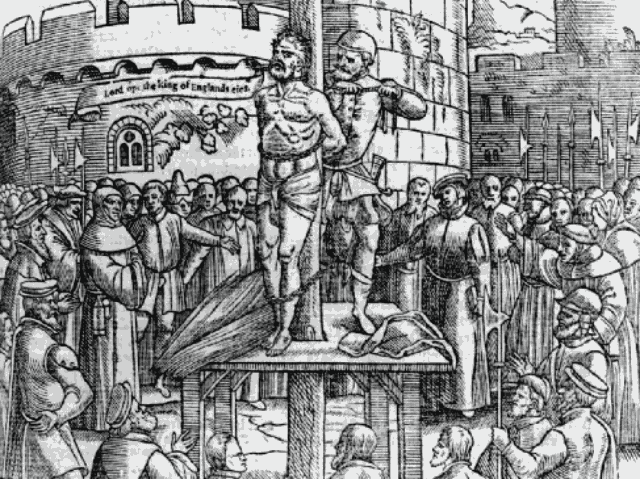
here, here, here and here (this last image is of the martyrdom of William Tyndale whose final prayer was "Lord, open the king of England's eyes". He wanted an English translation of the Bible for the common folk; this could only be done by the authority of the king.
While the images seem stylized, they nevertheless convey the experience of these martyrs. And Thomas Bilney was to be counted among them. He was convicted of heresy, but his friends pressured him and felt he would be throwing his life away just when he was spreading the gospel so successfully.
So he recanted; he was then paraded around a public area carrying fagots***** to remind him he had recanted and thus would not burn in an inferno of fagots. (See the images linked above to see the twigs and sticks bound together to provide this furnace of torture.) He was then returned to prison. *****At the site of Paul's Cross, he had to use his fagots to ignite and burn a stack of William Tyndale's Bibles.
However, the punishment of being burned at the stake was nothing compared to what was to come. The burning of William Tyndale's Bibles absolutely shattered him.
"After he spent a year in the Tower he returned to Cambridge, but he was so tortured by remorse that he had denied his Christ, that he could not bear to have anyone, not even his old friend Latimer, read or mention the Scriptures him. 'His mind wandered, the blood froze in his veins, he sank under his terrors; he lost all sense, and almost his life, and lay motionless in the arms of his astonished friends.' He could obtain no consolation."
"...he resolved to rectify the great wrong he had done. He determined never again to renounce the truth of God's Word."
He returned to Norfolk the town where he had first preached. He no longer had a license to preach and was soon apprehended.
"The night before [his] execution, friends who came to comfort, reminded him, 'Though the fire would be hot, God's spirit would cool it.' To show them his lack of fear he put his finger in the candle flame, leaving it there until it was burned off to the first joint. He told them, ' I feel by experience, and have known it long by philosophy, that fire by God's ordinance is naturally hot; but yet I am persuaded by God's Holy Word, and by the experience of some mentioned in the Word, that in the flame they felt no heat, and in the fire they felt no consumption; and I can constantly believe, however the stubble of this my body shall be wasted by it, yet my soul and spirit shall be purged thereby, a pain for the time, whereon, notwithstanding, followeth joy unspeakable.' He referred them to Isaiah 43:2 'When thou walkest through the fire, thou shalt not be burned; neither shall the flame kindle upon thee.'"
"'Little' Bilney was executed at Lollard's Pit..." faithful to his Christ and to the Truth of God's Word.
Like Little-Faith, Bilney faltered and stumbled in his Christian walk, but by God's grace and the Holy Spirit coming along side, he persevered to the end to give glory to his Savior and praise to his God.
quoted material taken from the Friends of William Tyndale site.
here, here, here and here (this last image is of the martyrdom of William Tyndale whose final prayer was "Lord, open the king of England's eyes". He wanted an English translation of the Bible for the common folk; this could only be done by the authority of the king.
While the images seem stylized, they nevertheless convey the experience of these martyrs. And Thomas Bilney was to be counted among them. He was convicted of heresy, but his friends pressured him and felt he would be throwing his life away just when he was spreading the gospel so successfully.
So he recanted; he was then paraded around a public area carrying fagots***** to remind him he had recanted and thus would not burn in an inferno of fagots. (See the images linked above to see the twigs and sticks bound together to provide this furnace of torture.) He was then returned to prison. *****At the site of Paul's Cross, he had to use his fagots to ignite and burn a stack of William Tyndale's Bibles.
However, the punishment of being burned at the stake was nothing compared to what was to come. The burning of William Tyndale's Bibles absolutely shattered him.
"After he spent a year in the Tower he returned to Cambridge, but he was so tortured by remorse that he had denied his Christ, that he could not bear to have anyone, not even his old friend Latimer, read or mention the Scriptures him. 'His mind wandered, the blood froze in his veins, he sank under his terrors; he lost all sense, and almost his life, and lay motionless in the arms of his astonished friends.' He could obtain no consolation."
"...he resolved to rectify the great wrong he had done. He determined never again to renounce the truth of God's Word."
He returned to Norfolk the town where he had first preached. He no longer had a license to preach and was soon apprehended.
"The night before [his] execution, friends who came to comfort, reminded him, 'Though the fire would be hot, God's spirit would cool it.' To show them his lack of fear he put his finger in the candle flame, leaving it there until it was burned off to the first joint. He told them, ' I feel by experience, and have known it long by philosophy, that fire by God's ordinance is naturally hot; but yet I am persuaded by God's Holy Word, and by the experience of some mentioned in the Word, that in the flame they felt no heat, and in the fire they felt no consumption; and I can constantly believe, however the stubble of this my body shall be wasted by it, yet my soul and spirit shall be purged thereby, a pain for the time, whereon, notwithstanding, followeth joy unspeakable.' He referred them to Isaiah 43:2 'When thou walkest through the fire, thou shalt not be burned; neither shall the flame kindle upon thee.'"
"'Little' Bilney was executed at Lollard's Pit..." faithful to his Christ and to the Truth of God's Word.
Like Little-Faith, Bilney faltered and stumbled in his Christian walk, but by God's grace and the Holy Spirit coming along side, he persevered to the end to give glory to his Savior and praise to his God.
quoted material taken from the Friends of William Tyndale site.
Saturday, August 8, 2009
back to Bilney
"Since he was of a shy and bashful nature, he did not at first with boldness preach to the world. It is written that his vocation was prayer...pleading for souls".
Bilney was the leader of the protestant group in Cambridge. He and several others began meeting secretly in the White Horse Inn to discuss these new Lutheran teachings.
"Any evangelist would be proud to count among his converts those that Bilney made, names that stand high in the Reformation's hall of fame, persons without whom the English Reformation would perhaps not have been accomplished. Of Cambridge's eminent professors, Arthur, Thistle, and Stafford were the first to respond to him Latimer, Barnes, Lambert, Warner, Fooke and Soude were also among those he converted. All were men who place formost roles in the English Reformation." In fact, "he is known to have converted more great men among the English Reformers than did anyone else."
Others he was associated with were Tyndale and Frith. Bilney quietly attempted to fit his presentation of or conversation about the Gospel to the person he wished to convert.
His intensity in his love for His Savior and the Word of God must have seemed incandescent & the response to the Gospel would have reminded us of the effect of the Gospel in
Acts 2
40 And with many other words he [Peter] testified and exhorted them, saying, "Be saved from this perverse generation."
41 Then those who gladly received his word were baptized; and that day about three thousand souls were added to them.
42 And they continued steadfastly in the apostles' doctrine and fellowship, and in the breaking of bread and prayers.
47 ...praising God and having favor with all the people. And the Lord added to the church daily those who were being saved.
Later Bilney became emboldened enough to preach. "It was not long, however, before opposition to his preaching developed. Twice monks forcibly drew him out of the pulpit."
This is only the beginning...
quoted material taken from the Friends of William Tyndale site. Information about Bilney specifically, is found here.
Bilney was the leader of the protestant group in Cambridge. He and several others began meeting secretly in the White Horse Inn to discuss these new Lutheran teachings.
"Any evangelist would be proud to count among his converts those that Bilney made, names that stand high in the Reformation's hall of fame, persons without whom the English Reformation would perhaps not have been accomplished. Of Cambridge's eminent professors, Arthur, Thistle, and Stafford were the first to respond to him Latimer, Barnes, Lambert, Warner, Fooke and Soude were also among those he converted. All were men who place formost roles in the English Reformation." In fact, "he is known to have converted more great men among the English Reformers than did anyone else."
Others he was associated with were Tyndale and Frith. Bilney quietly attempted to fit his presentation of or conversation about the Gospel to the person he wished to convert.
His intensity in his love for His Savior and the Word of God must have seemed incandescent & the response to the Gospel would have reminded us of the effect of the Gospel in
Acts 2
40 And with many other words he [Peter] testified and exhorted them, saying, "Be saved from this perverse generation."
41 Then those who gladly received his word were baptized; and that day about three thousand souls were added to them.
42 And they continued steadfastly in the apostles' doctrine and fellowship, and in the breaking of bread and prayers.
47 ...praising God and having favor with all the people. And the Lord added to the church daily those who were being saved.
Later Bilney became emboldened enough to preach. "It was not long, however, before opposition to his preaching developed. Twice monks forcibly drew him out of the pulpit."
This is only the beginning...
quoted material taken from the Friends of William Tyndale site. Information about Bilney specifically, is found here.
Friday, August 7, 2009
the story of "Little" Bilney
Paul was uniquely gifted by God for a very specific purpose,
Acts 9:
15 But the Lord said to him [Ananias], "Go, for he [Paul] is a chosen vessel of Mine to bear My name before Gentiles, kings, and the children of Israel.
16 For I will show him how many things he must suffer for My name's sake."
Jesus has confirmed that if the world persecuted Him, it will persecute His followers. Would we be prepared for that?
Have you ever heard of Thomas Bilney?
He was born in Norwich, England around 1495; he was a quiet, studious young man who was ordained as a priest in 1519. Like Luther, he made intense efforts to please God through vigils, fasting, confessing, going to mass, buying indulgences, ad nauseum. All to no effect, all to no achievement of peace of mind about his standing with God.
Just at this point in time, the Greek New Testament was circulating in the "underground". Imagine trying to be Christian with no Bible?!? The Latin Vulgate (Jerome 347AD-420AD), which had been translated by him a thousand years earlier, was the only translation for the West and was restricted to the churches and monasteries. Most people would have no idea what the Word of God had to say to them!
Erasmus (a Dutch humanist, ca 1466 to 1536) prepared important new Latin and Greek editions of the Bible in 1522. His Greek New Testament was circulating in England that time. It was the first time that a parallel version of the Bible had been published, with a column of Latin on one side of the page and Greek on the other.
Bilney was called "Little" Bilney because of his slight stature. His intense desire to be right with God and his unavailing efforts to achieve this, led him finally to "read it [the NT] in secret. With considerable fear he purchased a copy and locking himself in his room, he allowed the book to fall open, and he read, "This is a faithful saying, which is worthy of all acceptation, that Christ Jesus came into the world to save sinners; of whom I am chief." 1 Timothy 1:15
"Bilney grasped the idea readily, that if Paul thought himself the chief of sinners, and yet was saved, then he, Bilney, even a greater sinner in his own estimation, could be saved too. What a revelation! What a relief! Instead of despair, a great inward peace now came into his soul."
The Lord had saved him. What would be God's role for this newly saved saint in this turbulent, reformation era??
Stay tuned...
Acts 9:
15 But the Lord said to him [Ananias], "Go, for he [Paul] is a chosen vessel of Mine to bear My name before Gentiles, kings, and the children of Israel.
16 For I will show him how many things he must suffer for My name's sake."
Jesus has confirmed that if the world persecuted Him, it will persecute His followers. Would we be prepared for that?
Have you ever heard of Thomas Bilney?
He was born in Norwich, England around 1495; he was a quiet, studious young man who was ordained as a priest in 1519. Like Luther, he made intense efforts to please God through vigils, fasting, confessing, going to mass, buying indulgences, ad nauseum. All to no effect, all to no achievement of peace of mind about his standing with God.
Just at this point in time, the Greek New Testament was circulating in the "underground". Imagine trying to be Christian with no Bible?!? The Latin Vulgate (Jerome 347AD-420AD), which had been translated by him a thousand years earlier, was the only translation for the West and was restricted to the churches and monasteries. Most people would have no idea what the Word of God had to say to them!
Erasmus (a Dutch humanist, ca 1466 to 1536) prepared important new Latin and Greek editions of the Bible in 1522. His Greek New Testament was circulating in England that time. It was the first time that a parallel version of the Bible had been published, with a column of Latin on one side of the page and Greek on the other.
Bilney was called "Little" Bilney because of his slight stature. His intense desire to be right with God and his unavailing efforts to achieve this, led him finally to "read it [the NT] in secret. With considerable fear he purchased a copy and locking himself in his room, he allowed the book to fall open, and he read, "This is a faithful saying, which is worthy of all acceptation, that Christ Jesus came into the world to save sinners; of whom I am chief." 1 Timothy 1:15
"Bilney grasped the idea readily, that if Paul thought himself the chief of sinners, and yet was saved, then he, Bilney, even a greater sinner in his own estimation, could be saved too. What a revelation! What a relief! Instead of despair, a great inward peace now came into his soul."
The Lord had saved him. What would be God's role for this newly saved saint in this turbulent, reformation era??
Stay tuned...
Labels:
Biography,
Church History,
God's Words,
Heros of the faith,
Reformers
Thursday, August 6, 2009
the story of litte-faith
Then Christian said to Hopeful, "I recall now the story of Little-Faith (scroll down about 1/2 the page) who dwelt in the town of Sincere. The story is this: At the entering in at this passage, there comes down from Broadway Gate a lane called Dead Man's Lane; so-called because of the murders that are commonly done there; and this Little-Faith, going on pilgrimage as we do now, chanced to sit down there and fell asleep."
"Now, there happened at that time to come down that lane from Broadway Gate, three sturdy rogues, named Faint-Heart, Mistrust, and Guilt, three brothers; and they, espying Little-Faith,
came galloping up and with threats bade him stand and deliver his purse. But when he made to haste to do it (for he was loth to lose his money) Mistrust ran up to him and took from his pocket a bag of silver. Then he cried out, 'Thieves! thieves!' With that Guilt, with a great club, struck Little-Faith on the head, and felled him flat to the ground, where he lay bleeding as one that would bleed to death. All this while the thieves stood by."
"But hearing someone upon the road, and fearing it was Great-Grace that dwells in the city of Good-Confidence, they took to their heels and left this good man to shift for himself. Now, after a while Little-Faith came to himself and, getting up, made shift to scramble on his way. This was the story."
HOPEFUL. Did they take from him all that he had?
CHRISTIAN. No; the place where his jewels were they never found; so he kept them still. But he had scarce enough money to bring him to his journey's end; so he was forced to beg as he went, to keep himself alive, for his jewels he dared not sell, for if they were missing at the gate of the Celestial City, he would be shut out of an inheritance there.
HOPEFUL. But is it not a wonder they got not from him his certificate, by which, he was to be admitted at the Celestial Gate?
CHRISTIAN. It is a wonder; and it was more by good providence than by his effort, that they missed getting that good thing.
Then Christian sang:
This story comes from the book Pilgrim's Progress by John Bunyan, written while he was imprisoned (around 1675) for his faith in the Lord Jesus Christ.
"Now, there happened at that time to come down that lane from Broadway Gate, three sturdy rogues, named Faint-Heart, Mistrust, and Guilt, three brothers; and they, espying Little-Faith,
came galloping up and with threats bade him stand and deliver his purse. But when he made to haste to do it (for he was loth to lose his money) Mistrust ran up to him and took from his pocket a bag of silver. Then he cried out, 'Thieves! thieves!' With that Guilt, with a great club, struck Little-Faith on the head, and felled him flat to the ground, where he lay bleeding as one that would bleed to death. All this while the thieves stood by."
"But hearing someone upon the road, and fearing it was Great-Grace that dwells in the city of Good-Confidence, they took to their heels and left this good man to shift for himself. Now, after a while Little-Faith came to himself and, getting up, made shift to scramble on his way. This was the story."
HOPEFUL. Did they take from him all that he had?
CHRISTIAN. No; the place where his jewels were they never found; so he kept them still. But he had scarce enough money to bring him to his journey's end; so he was forced to beg as he went, to keep himself alive, for his jewels he dared not sell, for if they were missing at the gate of the Celestial City, he would be shut out of an inheritance there.
HOPEFUL. But is it not a wonder they got not from him his certificate, by which, he was to be admitted at the Celestial Gate?
CHRISTIAN. It is a wonder; and it was more by good providence than by his effort, that they missed getting that good thing.
Then Christian sang:
"Poor Little-Faith! hast been among the thieves?
Wast robbed? Remember this: whoso believes
And gets more faith, shall then a victor be
Over ten thousand: else scarce over three."
This story comes from the book Pilgrim's Progress by John Bunyan, written while he was imprisoned (around 1675) for his faith in the Lord Jesus Christ.
Subscribe to:
Comments (Atom)